top of page

JOHN MACAULEY ON EMBRACING CHANGE
John Macauley, along with his brother, Jeff, and father, Jim, raise beef cattle and farm a rotation of grain, corn, soybeans, and wheat on 1000 tillable acres of cropland at Macauley Farms LLC in Livingston, NY. In 2009, at his father’s suggestion, Macauley attended the National No-till Conference. He recalls filling a notebook from front to back with ideas he picked up from speakers and from mingling with other attendee farmers. Hoping that by switching to no-till the farm could save on time as well as labor and machinery costs, Macauley began implementing the practice on the Macauley Farm that year, with assistance from an NRCS EQIP contract that provided some financial assistance to farmers adopting no-tillage.

John Macauley (far right) with brother Jeff and father Jim raise beef cattle and farm grains on 1000 tillable acres in Livingston NY.
Macauley credits his progressive father for encouraging him to embrace this systemic change. “If you stay in the same track you never get out of the rut,” was the wisdom he had imbibed from Jim.
The ChallengeS of Adopting a No-Till Practice
Not that the transition to no-till has been without setbacks and frustrations for the farm. Every year has presented its challenges. The first spring Macauley purchased Dawn curved tines closing wheels for his corn planter. “They picked up golf ball size rocks,” he recalls, “and we realized they were not going to work for us.” He subsequently cycled through about half a dozen different closing wheel setups over a number of years before finally finding one that did the job. The trial and error process of converting from tillage to no till was costly, he reports: “I am glad I got some financial assistance from the NRCS program. Having good people at the NRCS really helped along the way.”
.jpeg)
What's left of a "7-way" cover crop mix at the end of the year.
Next step: Cover Cropping
In 2012, a few years after he had more or less mastered the art of no-till, Macauley attended another no-till conference, where he overheard an Illinois farmer complain that after adopting no-till his soil was “dead, there was nothing alive in it. No earthworms to be seen.” Another farmer talked about the success he was experiencing after adding a cover crop rotation to his no-till system, boasting: “You should see all the earth worms, spiders, bugs, and beetles.” That was all Macauley needed to hear. Shortly thereafter, he secured another NRCS contract and, after his wheat harvest, planted a cover crop seed mix of Austrian winter pea, radishes, and oats that had been recommended to him by the regional manager of his local seed supplier.
“I saw all that was happening,” he recalls. “My soil had a different smell and when I pulled back the cover crop the worms and bugs were running around in it.”
He now plants a cover crop mix of Austrian winter peas, hairy vetch, purple top turnips, radish, cereal rye, buckwheat, crimson clover, and has acquired first-hand knowledge of the benefits of multispecies cover cropping. “We want to get some nitrogen out of the cover crop,” he explains, “and the legumes are for that. The buckwheat is for getting phosphorus into soil particles, the radishes and turnip taproots are for the compaction, the cereal rye helps with weed control.”
Synthetic Fertilizer
Although the farm has not reduced the volume of synthetic fertilizer inputs since adopting cover-cropping, Macauley hopes that it will soon be possible. The farm’s yield averages have remained pretty much constant over the years both before and after implementing soil health practices—175 to 200 bushels of corn, 50-55 bushels of soybeans, 70-80 bushel of wheat per acre. The question now for Macauley is, can those synthetic inputs be reduced without sacrificing yield? The farm is now partnering with Cornell University to gauge whether that will be possible. “At the end of the day we have to be profitable,” Macauley says. He regrets not having established a test plot when he started cover cropping where he would have been able to observe the impacts on yield as he steadily decreased fertilizer. “I should have been doing that from the get go,” he says.

Planting through a cover crop mix.
A Healthy Soil Biome As Natural Pest Manager
Macauley has had considerable success reducing his use of pesticides and in fact has not applied any for the past eight years. That said, he does not rule out their use in the future, and assesses his need on an ongoing basis. He periodically scouts his fields to see if they have reached a threshold requiring an application.
He credits his soil health practices, principally cover cropping, for serving him well as an ecological pest management tool and acknowledges that if he sprays he will kill not only the pest targeted but the beneficial insects and microbial material that help build his crop’s defenses against disease. So he is always happy when he has concluded that the beneficials “can do the work.” Although the pesticide is a cheap option,” he says, “if I don’t have to spend the money, why do it?"
Herbicides
While the farm has significantly reduced the use of synthetic pesticides and hopes to reduce chemical fertilizer as well, Macauley reports that herbicides will likely continue to be integral to its management system. He maintains that it is difficult to suppress weeds without herbicides and weeds rob cash crops of both critical moisture and nutrients, which translates into lower yields and reduced profits for the farm. And while it is true that cover crops have a role to play in suppressing weeds and provide myriad other soil health benefits, a multispecies crop is particularly challenging to terminate without herbicides, Macauley reports. He typically roller crimps the cover crop, then plants into it, and in the next 7 days makes an herbicide pass to totally kill it. “With a multispecies cover crop mix some of it won’t be tall enough and it won’t crimp and die. For example, the vetch in the mix might be at the right point to be killed with a crimper but the peas and clover might be harder.” The crimp edges on the I & J MFG roller crimper that Macauley uses are 6-8" apart. Sometimes he finds the bigger plants in the cover crop mix, like cereal rye, lay on top of the smaller ones as they are crimped, smothering the smaller ones out. But he finds that isn’t always the case, and the smaller ones need to be killed with herbicide.
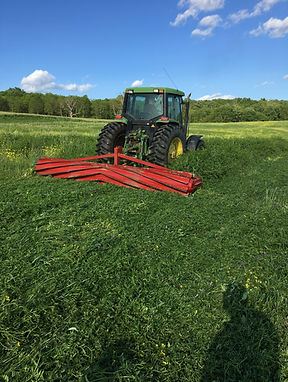
The farm's I&J 15' roller crimper.
Macauley acknowledges that it might be possible to terminate a single species cover crop—hairy vetch or cereal rye—without applying herbicide. But a mono-species cover crop doesn’t provide the diverse nutrient and aeration benefits of mixed species.
Timing is everything when planting green into a mixed-species cover crop, with or without herbicides, with a lot depending on the vagaries of weather, Macauley says. Each plant breaks down at a different time, releasing nutrients at different times through the growing season. “If you terminate a week to a month earlier than you plant your cash crop the nutrients are released sooner and the cover crop plant may not be at the optimum time to release them,” he explains. “But then again you don’t know what the year’s weather is going to be. If there is no rain and you delay terminating, then the cover crop sucks up all the available moisture and your cash crop has a hard start.”
Can A Farmer Take Nutrient Density to the Bank?
While farmers are compensated in the market based primarily on yield, Macauley has speculated on whether nutrient density will ever also have cash value that a farmer can take to the bank. “I have thought about that a lot and I look at it a couple different ways,” he says. “Yes I would like to get more nutrient dense food in my body. But when people go to the grocery store they only want to spend a certain amount. One hundred dollars doesn’t buy you much today, you get maybe 5 to 10 items in your shopping cart for it. How many people will want to spend that much more money for nutrient dense food?”
Building a Peer to Peer Knowledge-Sharing Network
Today as a seasoned no-till and cover-cropping farmer Macauley is happy to share his experiences with other farmers, but modestly offers the caveat that “it is just my opinion.” He sells corn and soybean seed to other farmers, giving them the opportunity to swap stories about their practices.
Macauley has also made connections through AFT’s Demonstration Farm Network workshops. "We call each other during the year and say, ‘what are you doing different this year?’” he says. “Farmers nowadays are more apt to share what they are doing.”
That willingness to share, he thinks, has much to do with social media. “I still watch a ton of YouTube videos on farming,” he says. “I go home at night and flip on my iPad and watch someone in Indiana and Tennessee and pick up ideas on how they are farming and then try to maybe implement it on my farm.”
Building Confidence Through Experience
Although Macauley plans to continue to use herbicides he believes that his experiences integrating soil health practices into his farming system has prepared him for the day, if and when it comes, when herbicides like glyphosate are no longer available. “If so," he says. “We have figured out we can roller crimp this cover crop down and get it killed, maybe not 100 percent, but we can plant into it and still have a cash crop.”
That said, as Macauley reports, the challenge for commodity grain farmers like him is that most are not in control of their pricing. The Chicago Board of Trade, and a world market dictates that. “So we need to keep our cost as low as possible to remain profitable,” he says. “If herbicides are banned that would be harder, but not impossible. It would just be more of a thought process,” he says.
bottom of page